
Single Post

Here is the scene. A cyclist is riding in a marked bike lane through a downtown business district. Parked cars line the curb to the right of the bike lane. Parked cars line the curb to the right of the bike lane. Car traffic in the through lane to the left is backed up, but the bike lane is clear. The cyclist keeps riding and passes the line of stopped cars. Without warning, one of those cars turns right, cuts across the bike lane toward an open parking space, and the two collide.
This article answers three questions:
- Can the cyclist legally pass backed-up cars in an open bike lane?
- Can the driver cross the bike lane to reach a parking space, and how must they do it?
- Who is at fault, and what can drivers and cyclists each do to prevent this crash?
The scene, diagrammed
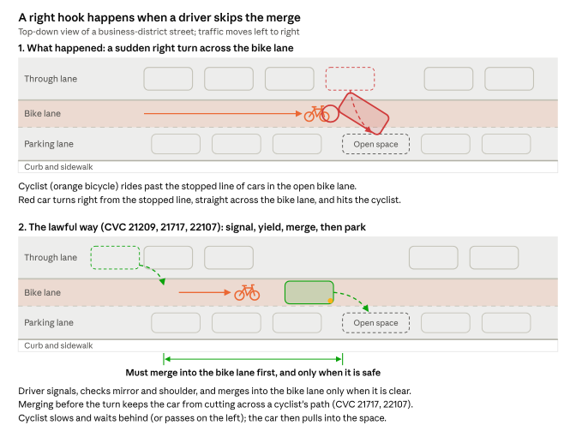
The crash scene vs. the lawful way to park across a bike lane
The top panel shows the crash. The bottom panel shows the same street when the driver signals, yields and merges into the bike lane before parking.
What CVC 21209 says
CVC 21209 starts with a ban: no one may drive a motor vehicle in a bike lane. It then lists three exceptions. A driver may enter a bike lane only:
- To park where parking is permitted.
- To enter or leave the roadway, such as turning into a driveway or alley.
- To prepare for a turn within 200 feet of an intersection.
Those three exceptions do not cancel the driver's other duties. Several related Vehicle Code sections control how the driver uses an exception:
| Section | What it requires |
|---|---|
| CVC 21209 | No driving in a bike lane except to park, enter or leave the roadway, or prepare for a turn within 200 feet of an intersection |
| CVC 21717 | A driver who must cross an adjacent bike lane to turn must first merge into the bike lane, then turn under CVC 22100 |
| CVC 22100 | Right turns are made as close as practicable to the right-hand curb or edge of the roadway |
| CVC 22107 | No turning or moving right or left until it can be done with reasonable safety, and only after a proper signal |
| CVC 22108 | A turn signal must be given continuously during the last 100 feet before turning |
| CVC 21208 | Cyclists riding slower than traffic must use an available bike lane, with listed exceptions |
| CVC 21200 | Cyclists have the same rights and duties as drivers, including the basic speed law (CVC 22350) |
Read together, these rules say the bike lane is the cyclist's lane. A driver may use it briefly for one of the three listed purposes, but must signal, check for bikes, yield, and wait for a safe gap first.
Question 1: Can the cyclist pass backed-up cars in the bike lane?
Yes. A cyclist riding in a marked bike lane may keep moving past cars stopped or crawling in the through lane. The cyclist is not "passing on the right" in the usual sense. They are traveling in their own designated lane, just as a car in a moving lane may pass cars stopped in a turn lane beside it.
California law supports this in two ways:
- CVC 21208 tells cyclists who are slower than normal traffic to ride in the bike lane. The law does not make them stop when cars beside them stop.
- CVC 21209 keeps cars out of the bike lane except in narrow cases, so the lane stays open for bikes.
Question 2: Can the driver cross the bike lane to park?
Yes, but only the right way. CVC 21209(a)(1) expressly allows a driver to enter a bike lane "to park where parking is permitted." The exception gives the driver permission to enter the lane. It does not give the driver the right-of-way over a cyclist already in it.
The lawful way to reach a curbside space across a bike lane:
- Signal early. CVC 22108 requires a continuous signal for the last 100 feet before the turn.
- Check mirrors and look over the right shoulder for cyclists coming up from behind, especially when traffic is stopped and the bike lane is open.
- Yield to any bicycle in or approaching the lane. CVC 22107 bars a turn until it can be made with reasonable safety.
- Merge into the bike lane first, then pull into the space. This follows the approach CVC 21717 requires for turns across a bike lane: the car moves into the lane once it is clear, so cyclists behind it stop or pass on the left instead of being cut off.
- Complete the move promptly. The exception covers entering to park, not driving down the bike lane looking for a space.
What the driver in our scene did, a sudden right turn from a stopped line of traffic straight across the bike lane, skips steps 1 through 4. Crash investigators call this a "right hook," and it is one of the most common causes of serious urban bike crashes. CVC 21209 does not excuse it. The driver used an allowed purpose (parking) in an unsafe way.
Who is at fault?
In this scenario the driver is the primary at-fault party. California fault analysis rests on two ideas.
Negligence per se. Under Evidence Code section 669, a person who violates a safety statute is presumed negligent if the violation caused the type of injury the statute was meant to prevent. A driver who turns across a bike lane without signaling, without looking, or without yielding likely violates CVC 22107 and 22108, and uses CVC 21209's parking exception unsafely. Those rules exist to protect cyclists in that very lane.
Evidence that often decides these cases: video from storefront, bus, or dash cameras; the car's turn-signal and event data; the police report and diagram; witness statements; bike computer or phone GPS speed data; and the damage pattern on the car's right side and the bicycle.
What drivers should do
The safest assumption in stopped traffic is that a bike is coming up on your right.
- Signal early and keep it on. Give at least 100 feet of signal, longer in slow traffic, so cyclists behind you can react.
- Mirror, then shoulder check. Side mirrors miss a cyclist beside your rear door. Turn your head before you move right.
- Merge into the bike lane, then park. When the lane is clear, move into it before you reach the space. Cyclists then stop behind you or pass on your left.
- Never cut straight across from a stopped line. If a bike is coming, wait. Losing the space costs far less than a crash.
- Don't drive along the bike lane hunting for parking. CVC 21209 lets you enter to park, not to cruise.
- Watch for bikes when leaving the space too. CVC 22106 requires a safe start from a parked position, and CVC 22517 requires checking before you open a door into traffic.
- Give three feet when passing a cyclist (CVC 21760), and change lanes to pass when you can.
What cyclists can do
Being in the right does not prevent an injury. When you pass stopped traffic, ride as if every car might turn.
- Scan ahead for open parking spaces, driveways and gaps. Those are where right hooks happen.
- Read the car, not just the driver. Watch for blinking signals, brake lights, front wheels angling right and drivers turning their heads.
- Don't ride into a car's blind spot near a turn point. Hang back, or pass on the left in the travel lane when it is safe and legal (CVC 21208 allows leaving the bike lane to pass or avoid hazards).
- Be seen. Use a bright front light and rear light, day and night. A white front light is required after dark (CVC 21201).
- Cover your brakes with fingers resting on the levers through busy blocks.
- Record your ride. A handlebar or helmet camera is often the best evidence after a crash.
If you are hit: call 911, get medical care, photograph the scene and both vehicles, get the driver's and witnesses' contact information, ask nearby businesses to save their video, and keep your damaged bike and gear as they are.
The bottom line
A cyclist may lawfully ride past backed-up traffic in an open bike lane at a safe speed. A driver may cross that lane to park, but only after signaling, looking, yielding and merging in safely. When a driver turns suddenly across the lane and hits a cyclist, CVC 21209 does not protect the driver. The driver will usually carry most of the fault.
If you or someone you love was hit while riding in a bike lane, Halpern Law Firm can review what happened and explain your options. Contact us for a free consultation.
This article is general information, not legal advice. Every crash turns on its own facts. Reading it does not create an attorney-client relationship.